Houston is one of the fastest-growing major cities in the United States, and that growth has a direct relationship with building teardown. As the metro region expands, older commercial buildings, industrial facilities, and residential structures are regularly replaced by new development. Houston’s lack of traditional zoning replaced by the deed restriction system governing much of the city’s land use creates a more fluid redevelopment environment than most American cities, and Building Teardown Houston are a common feature of that ongoing transformation.
What Is a Building Teardown?
A building teardown also called a full demolition or complete demolition is the total removal of a structure and its below-grade elements to create a cleared site. This distinguishes it from selective demolition (which removes only specific portions of a structure), interior demolition (which strips interior elements while the shell remains), and deconstruction (which carefully disassembles for material salvage). A teardown results in a fully cleared, grade-restored site ready for new development or other use.
Building teardowns in Houston span the full range of structure types. Commercial teardowns include retail buildings, restaurants, office structures, warehouses, and small manufacturing facilities. Industrial teardowns involve larger manufacturing plants, distribution centers, and process facilities. Residential teardowns range from single-family homes to larger apartment complexes. Houston’s unique development patterns including significant teardown-and-rebuild activity in desirable close-in neighborhoods like West University, River Oaks, Meyerland, and Bellaire create substantial demand across all these categories.
Pre-Teardown Requirements in Houston
Houston requires demolition permits for building teardowns through the Department of Neighborhoods (for residential structures) and Development Services Department (for commercial structures). Hazardous material assessment is required by TCEQ before demolition of structures that may contain asbestos. Houston’s older commercial, industrial, and residential building stock built before 1980 may contain asbestos in pipe insulation, boiler insulation, floor tiles, ceiling tiles, roofing products, and joint compound. If regulated materials are found, a licensed abatement contractor must properly remove and dispose of them before teardown proceeds.
Lead-based paint is prevalent in pre-1978 structures and affects debris handling and disposal requirements. Dust from demolition of lead-painted surfaces can create health hazards, and responsible contractors manage this through dust suppression and appropriate disposal protocols.
Utility disconnection is an absolute prerequisite before physical teardown begins. All gas, electric, water, and sewer connections must be properly disconnected and capped by respective utility providers CenterPoint Energy for gas and electric, and the relevant water utility. Failure to properly disconnect utilities before teardown creates life-safety risks including gas explosions, electrocution, and flooding.
The Physical Teardown Process
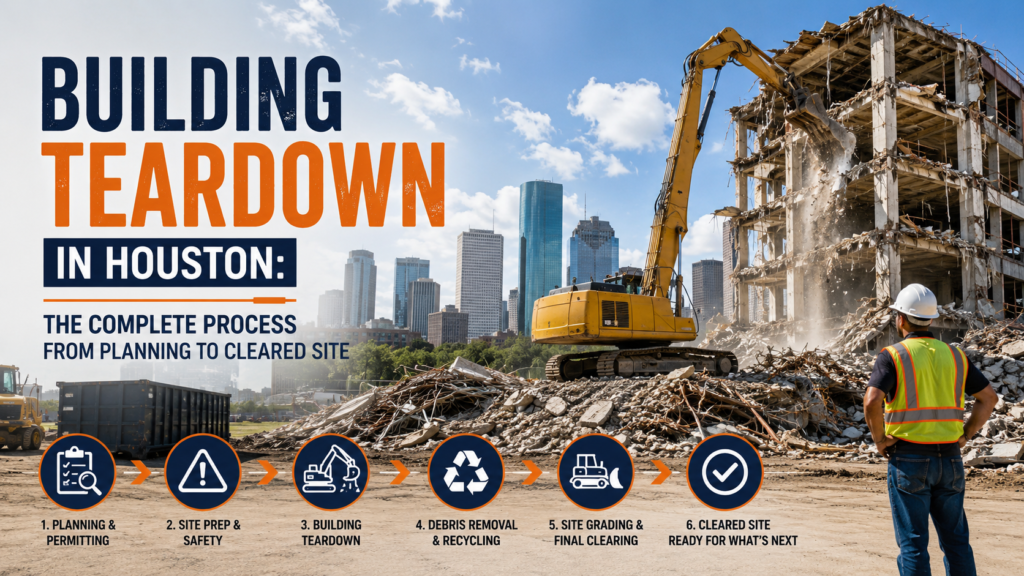
With permits secured, hazardous materials abated, and utilities disconnected, the physical teardown can proceed. For most Houston commercial and residential structures, mechanical demolition with excavators is the primary approach. Excavator operators methodically dismantle the structure, typically beginning with the roof and upper floors and working progressively downward. Houston’s prevalent tilt-wall concrete construction used widely in commercial and industrial buildings presents specific teardown considerations. These large, heavy concrete panels must be carefully toppled in sequence to avoid unexpected collapse and allow efficient debris processing.
Dust suppression is actively managed throughout the teardown. Houston’s heat and dry periods mean construction dust can spread widely, and responsible demolition contractors use water misting systems to keep dust under control. This protects adjacent properties and complies with Harris County air quality requirements.
Debris is sorted and loaded continuously during the teardown. Metal elements are separated for scrap metal recycling. Concrete is typically recycled as crushed aggregate. Wood and general demolition debris go to permitted disposal facilities. The City of Houston operates a Reuse Warehouse at 9003 N. Main that accepts donated salvaged construction materials, and Habitat for Humanity’s ReStore program also accepts building materials for resale to support affordable housing.
Foundation Removal and Site Restoration
After the above-grade structure is demolished, the foundation is addressed. Houston’s common slab-on-grade foundations are broken with hydraulic breakers and removed. The resulting excavation void is backfilled with clean, compactable fill material and compacted in lifts particularly important given Houston’s expansive clay soils, where properly compacted backfill prevents differential settlement of the cleared site surface over time.
Site restoration brings the teardown to its conclusion. The cleared site is graded to establish positive drainage toward drainage infrastructure. In Houston, where stormwater management is a critical concern given the region’s susceptibility to flooding, proper lot grading is both a practical and regulatory requirement.
Common Questions About Building Teardowns in Houston
How long does a commercial building teardown take? Duration depends on building size, construction type, and the scope of abatement required. A small commercial building might be torn down in a few days. Larger structures with significant asbestos abatement requirements may require weeks or months for the complete project.
What permits are required for a commercial building teardown in Houston? The City requires a demolition permit through the Development Services Department. Additional requirements may apply including TCEQ notification for asbestos-containing structures, Harris County stormwater permits, and coordination with CenterPoint Energy and utility providers for disconnections.